Some mornings do not need a better plan.
They need one tiny win.
Not a motivational quote. Not a 17-step productivity system. Not a color-coded calendar that looks like it was assembled by a very calm alien.
Just one task small enough to start, real enough to matter, and visible enough to tell your brain: we are moving now.
That small win can change the shape of the whole day.
Not because it magically solves everything. Because starting is often the hardest part of work, and most productivity systems quietly pretend it is not.
What is a small win in productivity?
A small win is a task that is easy to finish but still meaningful.
It is not busywork. It is not fake productivity. It is a low-friction action that creates visible progress.
Examples:
- replying to one important message;
- turning a messy note into a task;
- sending the follow-up you have avoided for two days;
- choosing the first step of a bigger project;
- clearing one blocker before starting deep work;
- making the plan for the next 30 minutes instead of the whole week.
The point is not that the small task is the most important thing on your list.
The point is that it makes the next task easier to start.
That is the part most todo apps miss.
The momentum gap
Here is the Nala framing:
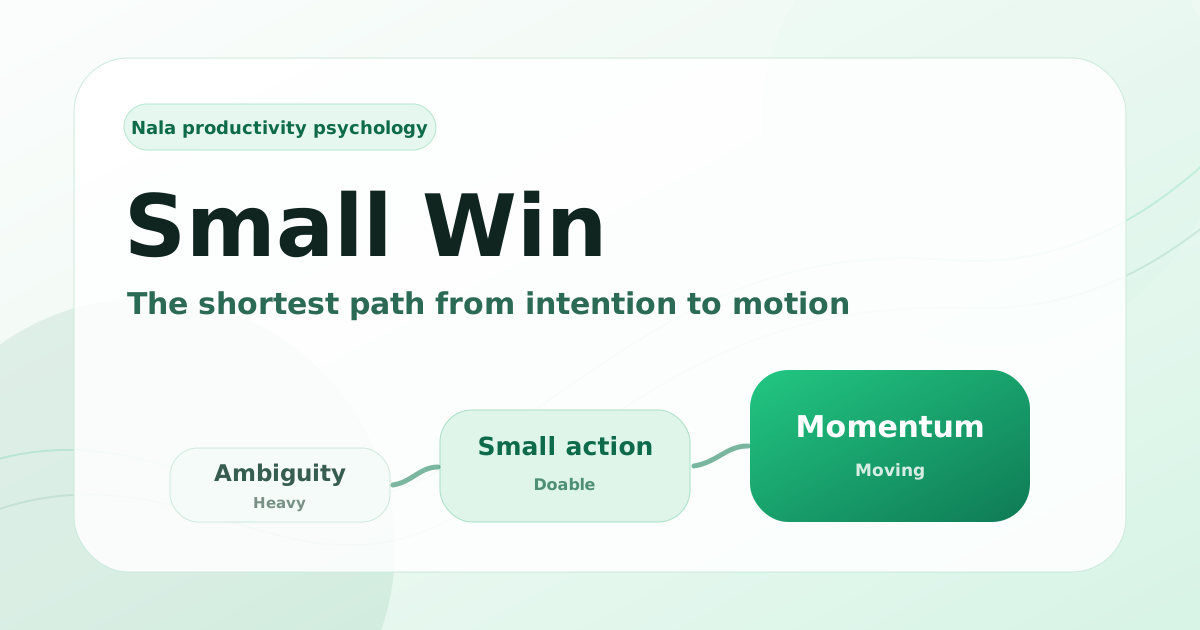
The hardest part of productivity is often not knowing what matters. It is crossing the gap between knowing and moving.
We can call that gap the momentum gap.
The momentum gap is the distance between:
- “I know I have work to do”
- and “I am actually doing the first useful thing.”
A lot of task systems are good at the first part. They store everything. They categorize everything. They let you tag, sort, filter, color, schedule, and reschedule your tasks until your anxiety has a full-time assistant.
But they do not always help you cross the moment where work becomes action.
That moment is emotional. It is not just logistical.
You may know the important task. You may know the deadline. You may even know the next step.
Still, the task can feel heavy.
That heaviness usually comes from a mix of ambiguity, effort, pressure, and a tiny loss of trust in your own system.
A small win lowers the pressure enough to move.
The Nala Small Win Ladder
A useful assistant should not only ask, “What is most important?”
Sometimes it should ask:
“What is the smallest useful thing that will make the next task easier?”
That is the idea behind the Nala Small Win Ladder.
Step 1: Make it visible
The task has to be clear enough that you can see the finish line.
Bad:
Work on launch.
Better:
Write the first draft of the launch email subject line.
The second one is not the whole project. That is the point. It gives the brain a door handle.
Step 2: Make it finishable
A good small win should be finishable in a short window.
Usually 2–15 minutes.
If it takes longer, it might still be valuable, but it is no longer a starter task. It is the main event wearing a fake mustache.
Step 3: Make it connected
The task should connect to something that matters.
“Clean desktop icons” might feel nice, but if it has no relationship to the real work, it can become avoidance in a productivity costume.
A useful small win creates movement toward the real thing.
Step 4: Make the next action obvious
The best small wins leave a trail.
After finishing them, you should know what comes next.
That is why “send the follow-up” is stronger than “organize inbox.” It creates a real-world response loop. Something can now move.
Why perfect planning can backfire
Planning feels productive because it reduces uncertainty.
But planning can also become a safe place to hide from starting.
A perfect plan has a seductive promise:
Once everything is clear, I will begin.
The problem is that clarity often arrives after action, not before it.
You write one sentence and discover the angle. You send one message and unblock the project. You open the file and realize the task is smaller than it felt in your head.
This is why the first tiny action is not a trick. It is information.
Starting teaches you things planning cannot.
Why this matters for AI task managers
A normal task app can sort your list.
An AI task manager should do something more useful: help you move.
That means it should understand that “priority” is not the only variable.
A task can be important and still be a terrible first task for the day.
A task can be small and still be the right move because it creates momentum, removes friction, or rebuilds trust.
For Nala, this is an important product idea.
Nala should not only optimize tasks like a spreadsheet. She should understand that humans are not spreadsheets with coffee.
A personal assistant should notice:
- which tasks are important;
- which tasks are emotionally heavy;
- which tasks are ambiguous;
- which tasks unlock other tasks;
- which small action could get the day moving.
That is where productivity psychology becomes product design.
A simple small-win method you can use today
Before starting your day, ask four questions:
- What task matters today?
- What part of it feels heavy?
- What is the smallest useful action connected to it?
- After I finish that, what becomes easier?
Then do that first.
Not forever. Not as a personality. Just for the first movement of the day.
Example:
Big task:
Prepare investor update.
Heavy part:
I do not know how to frame the progress.
Small win:
Write three bullet points: what changed, what is working, what is still risky.
Next action:
Turn the bullets into the email draft.
That is a better start than staring at “Prepare investor update” like it owes you money.
Small wins are not about lowering ambition
This is the part people get wrong.
Starting small does not mean thinking small.
It means respecting the fact that momentum is real.
A small win is not the ceiling. It is the ignition.
The goal is not to spend the whole day doing tiny tasks. The goal is to use one small, meaningful action to make the bigger work easier to enter.
In a good productivity system, small wins are not random. They are chosen because they connect to important work.
That distinction matters.
Busywork drains the day. Small wins open it.
What Nala should eventually help with
In the future, an assistant like Nala should be able to look at a messy task list and say something like:
“This project is important, but the first step is vague. Want to start with a small win: write the three decisions you need to make?”
Or:
“You have a few heavy tasks today. The fastest useful win is probably sending this follow-up, because it unblocks someone else.”
Or:
“This is not the highest-priority task, but it is the one most likely to get you moving.”
That is the difference between managing tasks and assisting a human.
A task manager stores what you should do.
A personal assistant helps you begin.
The takeaway
If your day feels stuck, do not always look for the perfect plan.
Look for the smallest useful win.
A small win works because it crosses the momentum gap. It turns the day from abstract pressure into visible motion.
And once you are moving, the next task is usually less scary.
That is the kind of productivity Nala should be built around: not just more organized lists, but better human movement.
FAQ
Is starting with a small win just procrastination?
It can be, if the task is unrelated to meaningful work. A good small win should connect to something important and make the next action easier.
Should I always start with the easiest task?
No. The easiest task is not always the right one. The best small win is small, finishable, and connected to the work that matters.
How does this apply to an AI task manager?
An AI task manager should not only sort tasks by priority. It should help identify which action reduces friction and helps the user actually start.
What is the momentum gap?
The momentum gap is the distance between knowing what you should do and actually beginning the first useful action.