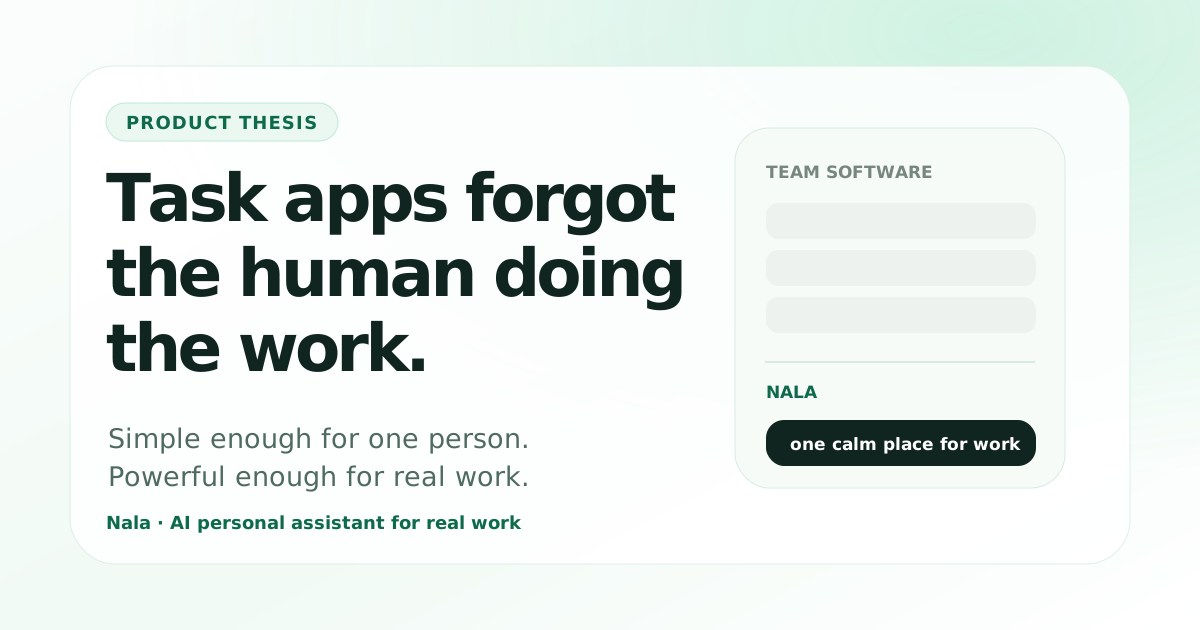
Most task apps feel like they were built for one of two worlds.
The first world is the basic checklist. Add task. Check task. Maybe set a reminder if the app is feeling ambitious.
The second world is team software. Boards, tickets, labels, owners, priorities, statuses, sprints, automations, permissions, dashboards, and enough workflow vocabulary to make a simple errand feel like it needs a steering committee.
Both worlds make sense.
But there is a very real person sitting between them.
The person carrying the work does not need another system to manage. They need help moving the work.
The missing user is not a team. It is one overloaded human.
A founder. A business owner. A freelancer. A creator. A builder. A person with clients, ideas, personal errands, follow-ups, deadlines, half-written notes, and three things they promised themselves they would remember without writing down.
That person does not always need enterprise project management.
They also do not need a toy checklist that forgets everything the moment the task is saved.
They need a task app that understands a very normal problem: real work is personal before it becomes organized.
Basic TODO apps
Fast to capture, but often too shallow once the task needs context, memory, follow-up, or help.
Team systems
Powerful, but often built around process. Great for departments. Heavy for one person trying to clear their head.
Nala’s direction
A personal assistant layer: simple capture, human context, useful memory, and AI that can help move tasks instead of just storing them.
Most apps organize work after you already understand it.
That is the subtle problem.
Traditional task apps are good when the task is already clear: “send invoice,” “call Alex,” “finish deck.”
But a lot of real work enters your brain as something much messier:
- “Need to follow up with that client but I forgot what we decided.”
- “This idea belongs to the new product page, but not now.”
- “I need to do something with the meeting notes before they die in a chat.”
- “This is probably a task for an agent later, but I need it captured first.”
- “I know this matters. I do not know where it goes yet.”
That is where a plain checklist becomes too thin.
And it is where a heavy team tool becomes too much.
Nala is being built for the moment before everything is neatly organized.
The idea is not to make another place where tasks sit politely in rows.
The idea is to build a personal assistant that can catch messy intent, hold context, and help turn it into movement.
Sometimes that movement is simple: create the task, set the time, remind me later.
Sometimes it needs more structure: connect it to a client, a project, a date, a note, a priority, or a calendar moment.
And sometimes the direction is bigger: this task should eventually move to an AI agent, with enough context that the user does not become the babysitter of the bot.
That is the difference between a TODO list and an AI task manager.
Simple does not mean weak.
This is where task apps often make the wrong trade-off.
Some products stay simple by staying shallow. That feels good on day one and limiting by day ten.
Other products become powerful by becoming heavy. That works for teams with managers, processes, and patience. It does not always work for one person who just wants the app to understand what they meant and help them move.
Nala is aiming at a harder balance:
- Simple enough to open without mentally preparing yourself.
- Human enough to handle unfinished thoughts.
- Structured enough for serious work.
- Personal enough to remember how you work.
- Powerful enough to bring AI and agents into the flow without making the user manage another machine.
The app should feel like it is on your side.
This is why the small UX work matters so much.
If a task app is going to hold more than a checklist, it cannot feel heavy in the hand. The keyboard has to behave. The edit sheet has to feel calm. The controls need hierarchy. Notifications have to take you to the right place. The app has to respect the user’s scroll, attention, and time.
Because the product promise is not “we have more fields.”
The promise is: the work can get out of your head without becoming another job.
Not another productivity temple.
People do not need a perfect productivity religion.
They need a place to put the thing before it leaks out of their brain.
They need the app to remember what matters.
They need enough structure to move, but not so much structure that starting becomes the hard part.
That is the product space Nala is being built for: not a toy checklist, not a corporate command center, but a personal assistant for real work.
The product lesson
The future of task apps is not just prettier checkboxes or bigger team boards.
- Tasks need context.
- Context needs memory.
- Memory needs a calm interface.
- AI needs to reduce work, not create another workflow.
- The human doing the work should stay at the center.
That is the bet: a task app can be simple, human, and seriously capable at the same time.
Quick answers
Is Nala a normal TODO app?
Nala includes task management, but the direction is broader: a personal assistant that can hold context, remember how work fits together, and help move tasks forward.
Is Nala built for teams?
Nala is being built around the individual first. It may touch client or business work, but the core idea is helping the person carrying the work, not recreating a heavy team workflow system.
Why mention AI agents in a task app?
Because some work should not stop at “remember this.” The long-term direction is that tasks can carry enough context to become useful handoffs, including to AI agents when that is the right next step.