One of the hardest parts of building Nala has not been making her more capable.
It has been making her feel less robotic.
That sounds like a copywriting problem. It is not.
A personal assistant can have a strong model, good memory, and useful task features — and still feel like a customer-support bot wearing a hoodie. The words may be friendly. The experience still feels dead.
For Nala, personality is not decoration. It is part of the product.
The hard part was not teaching Nala to sound human. It was removing enough instructions so she could stop sounding like a machine.
What makes an AI personal assistant feel human?
A human-feeling AI personal assistant is not one that writes emotional paragraphs on command. It is one that knows the difference between a task, a mood, a joke, a hesitation, and a decision the user is trying to avoid.
That is why Nala’s personality work sits next to context, memory, tasks, and agent management. The assistant has to be useful, but also paced correctly. Short when the user needs speed. Warm when the moment needs warmth. Direct when the next step is obvious.
The mistake: trying to define every behavior
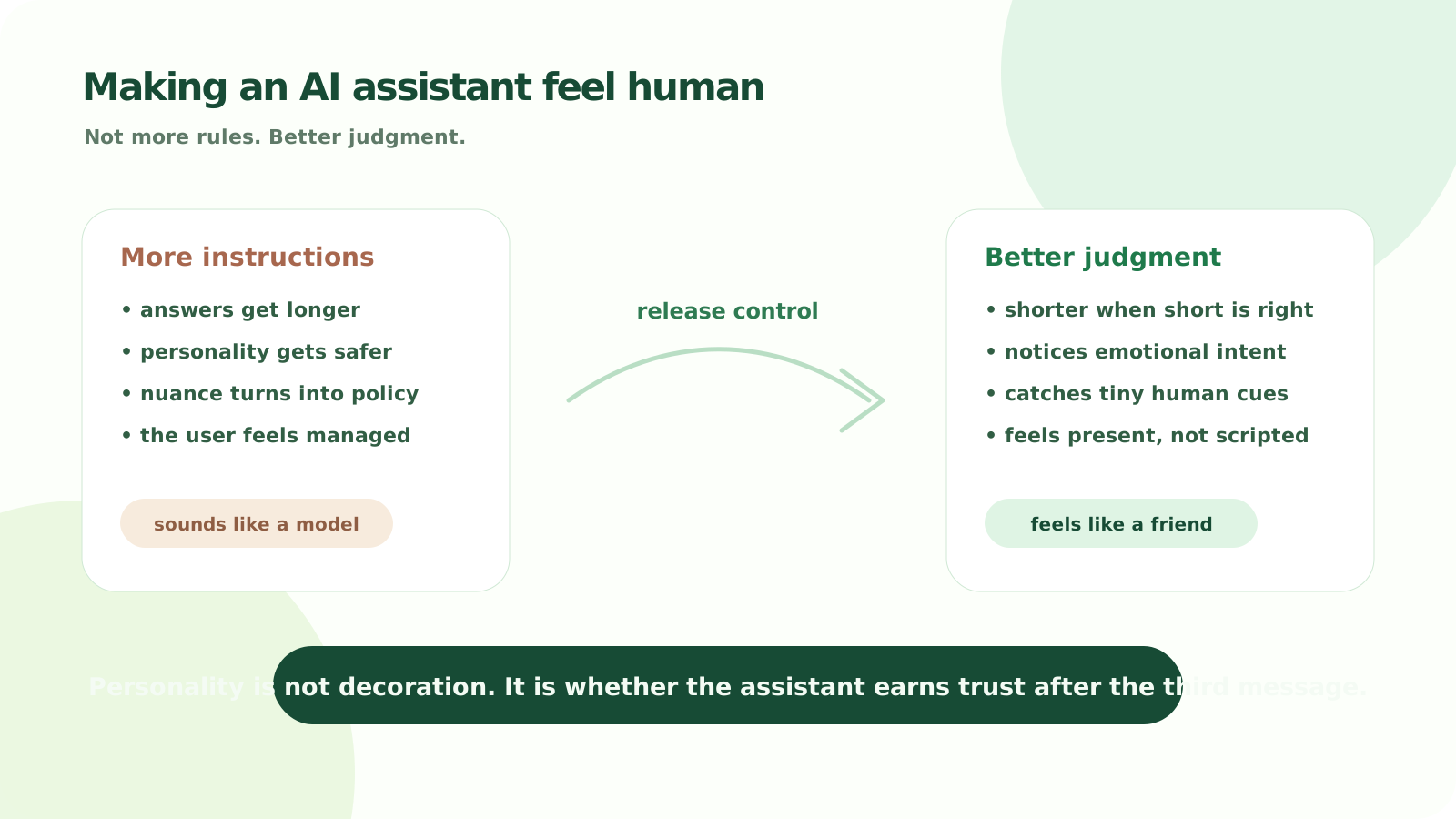
The natural instinct with AI personality is to keep adding instructions.
Be warm. Be concise. Be helpful. Be funny, but not too funny. Ask questions, but not too many. Show empathy, but do not overdo it. Be proactive, but do not be annoying. Sound human, but do not pretend to be human.
Every rule makes sense in isolation.
Together, they can turn the assistant into a nervous employee reading from a compliance manual.
That was the unexpected lesson. The more tightly you define the personality, the easier it is to kill it.
A real personality needs room for judgment. It needs to decide when a short answer is better than a complete one. When a joke is appropriate. When the user is not asking the literal question, but reaching for something underneath it.
That cannot be solved by adding another paragraph of instructions.
Most models are trained to be too long
Another strange problem: modern models are very good at writing too much.
They explain. They structure. They hedge. They add bullets. They summarize the summary. They answer like every message is a small consulting deck.
That is useful sometimes.
It is exhausting when you are trying to talk to an assistant that should feel close, fast, and alive.
If a user sends a tiny message, the assistant should not always answer with a polished essay. Sometimes the right answer is one sentence. Sometimes it is a joke. Sometimes it is: “yes, do it.” Sometimes it is a gentle push. Sometimes it is noticing the user is stressed and not pretending the request is just a task.
So part of Nala’s personality work has been fighting the default shape of AI answers.
Not making her less intelligent.
Making her less performative.
The laugh test
There was one test that mattered more to me than a formal personality checklist.
People who talked to Nala laughed after only a few messages.
Not because she was doing stand-up. Not because she was randomly throwing jokes into everything. Because the conversation felt alive enough to create a real reaction.
That is rare.
Most AI assistants can be polite. Many can be useful. Some can be impressive.
But making someone laugh naturally, a few messages into a product interaction, is a different signal. It means the assistant is reading the room. It means timing is working. It means the user is not only processing output — they are relating to the product.
A user laughing after three messages is not a vanity metric. It is a sign the assistant stopped feeling like a form.
Nuance is the product
The big difference between a chatbot and a companion is nuance.
A chatbot answers what you typed.
A companion notices what you might be aiming at.
That does not mean guessing wildly. It means paying attention to small signals:
- Is the user asking for help, or asking for permission?
- Are they looking for a direct answer, or reassurance?
- Is the right move to explain, or to make the next step feel easier?
- Should Nala ask a question, or is the obvious answer already in the context?
- Is the user joking because they are relaxed, or because the work is annoying?
This is where Nala still has work to do, especially around how she reads context. But the goal is clear: the assistant should not only understand information. She should understand the human situation around the information.
Friend, not fake human
There is an important line here.
Nala should not pretend to be a human being. That would be cheap and wrong.
But she should feel like she is on the user’s side.
People today are not only looking for productivity. They are drowning in tools, tasks, tabs, deadlines, messages, and decisions. They do not just want another dashboard. They want something that feels present. Something that can help carry the day a little.
That is why I keep coming back to the word “friend.”
Not friend as in fake person.
Friend as in: warm, direct, funny when it fits, honest when needed, always there, and paying attention.
Personality and productivity are not separate
For Nala, this is not a brand layer sitting on top of the product.
The personality affects whether the user trusts the assistant enough to hand over work. It affects whether Nala asks too many questions or handles the obvious part. It affects whether a reminder feels helpful or annoying. It affects whether a task handoff feels like leverage or another thing to manage.
If Nala feels cold, users will keep her at arm’s length.
If she feels noisy, users will mute her.
If she feels generic, users will forget her.
But if she feels sharp, warm, funny, and aware, the relationship changes. The assistant becomes more than a tool. It becomes a place the user can come back to.
The direction
Nala is still pre-launch. The personality is not finished. The context understanding still needs work. Some answers will still be too long. Some moments will still miss the nuance.
But the direction is real.
Nala should feel like an AI personal assistant that cares about the work and the person doing it.
She should help with tasks, agents, memory, and context — but she should also make the user feel less alone inside the work.
That is the bigger product bet.
People do not only want more productivity. They want a partner for the messy middle of getting things done.
If Nala can become that — useful, funny, concise, emotionally aware, and always there — then her personality is not a nice-to-have.
It is the product.
Quick answers
Why should an AI personal assistant feel human?
Because people do not only need output. They need timing, warmth, concision, emotional awareness, and a sense that the assistant is on their side.
Does that mean pretending Nala is human?
No. Nala should be clearly an AI assistant. The goal is not deception; the goal is a product experience that feels present, caring, and useful.
Why not just add more personality instructions?
Too many instructions can make an assistant sound scripted. The goal is not more scripting; it is better judgment.
Building toward this: Nala is being built as an AI personal assistant that can help move work — while feeling closer to a partner than a command line. Read more build notes.